21 November, 2026
Going deaf in my own language
Code was my second mother tongue. Now everyone speaks it. What could go wrong?
I've seen things you people wouldn't believe. [...] All those moments will be lost in time, like tears in rain. Time to die().
Roy Batty - Blade Runner (1982)
I have two mother tongues. One is Vietnamese, and the other is... programming languages.
Everything started in the summer of 2005, when I was a 7-year-old kid. Back then, ADSL was something new in Vietnam, but not out of people's reach.
Internet cafes were quite popular and were a practical way for people to access the internet. Indeed, many of my friends were going to internet cafes to play online games, and some became addicted to them. Fearing that, my parents prohibited me from going to internet cafes, even though I was very curious about the internet and had next to no interest in online games.
One day, accompanied by my uncle to his workplace, I had the chance to access the internet for the first time.
It was a magical experience.
That single moment sparked my curiosity. With my limited English proficiency, I started to explore the internet, learn HTML, CSS, and JS, and, for the first time, code myself a simple localhost website.
At school, I learned English, but I was never good at it. At home, I was discovering the world of computers and programming, tinkering with software, hardware, and even learning some basic electronics. That was so much fun for a secondary school student.
I could write code before I could hold a conversation in English.
Years passed, and I was a 17-year-old high school student. In the summer of 2015, I broke up with my GF, and my tiny heart was broken. Around the same time, I heard about something called "Ubuntu". With nothing else to cheer me up after the breakup, I decided to install Ubuntu on my PC and try to compile the Linux kernel from source code. And damn, that was a hell of a ride. But ultimately, I was able to compile and flash it to my Android phone. My first open source project was born, it's called Nui Kernel. That was so much fun.
Many years later, here I am, a 28-year-old software engineer. I have been working in the software industry for... I don't even know how long. But one thing I know for sure: the programming languages that I learned and used for years have become my second mother tongue. I can natively think in almost any programming language: C, C++, Java, Python, JavaScript, PHP, etc.
The one event in 2022 changed the world forever: ChatGPT was released to the public, and it reshaped the way we think about programming.
At the beginning, hardly anyone (me included) thought that one day, AI would be able to write fully functional software from scratch. But now, it is possible. Sometimes, I just feel like Reginald Barclay walking into the holodeck and asking the computer to create a neural scan interface. And the computer did it, well, sort of.
I, myself, make use of AI to write code, from my initial success with Deepseek to my current day-to-day work. I can now write more code than ever, faster than ever, and even better optimized than I ever could. I still, however, always make sure to read and understand the code that AI generates. I don't often read text generated by AI, because natural language can be ambiguous, but code cannot. Code is precise, and it's the most efficient way for me to understand the context.
The broader effect was that everyone can now suddenly write code - my mother tongue - without having to learn it. At the beginning, it was cool, but little by little, I started to feel like I was walking into a mist: people generate code using AI and hand it to me for review, even though they never looked at it, never understood it, and never even tried to learn it. The internet stories were all about "stop reading the code," or "English becomes the new programming language," or "stop learning programming languages, just use AI." Sounds simple, right? Just prompt the AI to write the code, then to check it, then to maintain it. From a production standpoint, it's not important who owns the code, you or the AI, and that's true; there is no question about that.
But my problem is that when I read the code, I can guess the reason behind certain choices. I believe it's not just an artifact of years of reading and writing code, but also quite a useful skill for judging the quality of the code based on its context.
I remember the first time I came across my therapist's website. I looked at the code behind it, viewed the .map file that the developer had mistakenly left behind, and was able to guess that the person might have an interesting relationship with the therapist. That turned out to be true: the developer was someone with a personal connection to the practice. I was able to guess that because of the way the code was structured, the half-finished features, and the comments left behind. It was like reading a diary written in code.
In a new world where code is generated by AI, even though the comment-to-code ratio is higher than ever, I feel like I'm losing my ability to read and understand code, left alone to guess the reason behind the curtain.
The code that used to be my second mother tongue now feels like a foreign language to me. I feel like I'm going deaf in my own language.
Like everyone else in the domain, I don't have much choice but to find a way to adapt. I have to use AI to optimize my workflow, to ship features faster, to write more code than ever. There is no doubt that, step by step, I will be able to match the new standard of productivity that the industry expects.
But things may never be the same again.
The joy of reading the code, and appreciating it like a piece of art.
The joy of understanding the code, and appreciating it like a piece of literature.
The joy of learning from the code, and appreciating it like a piece of history.
The joy of running the code, and appreciating it like a piece of music.
"All those moments will be lost in time, like tears in rain."
I'm writing this post not because I want to complain about the current state of the software industry. But just like Roy Batty, I want to share my experience, to remind myself who I really am, and what brought me here.
For you, the reader, I hope you can find your own way to adapt to the new world, and maybe find joy in the process.
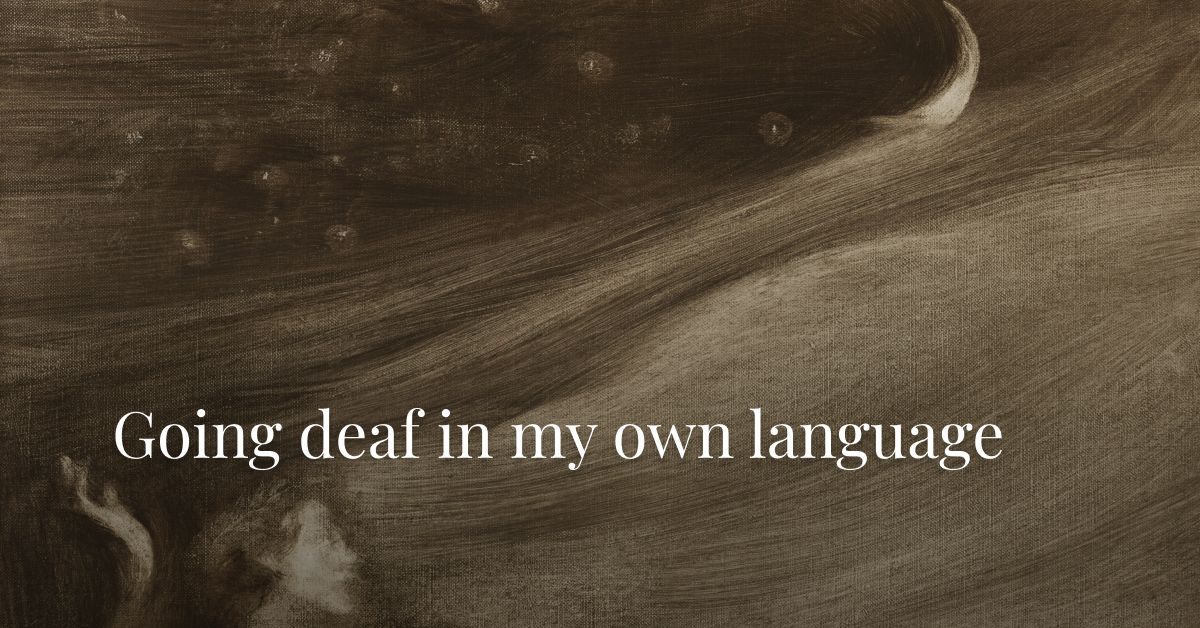
Cover photo by The Cleveland Museum of Art